
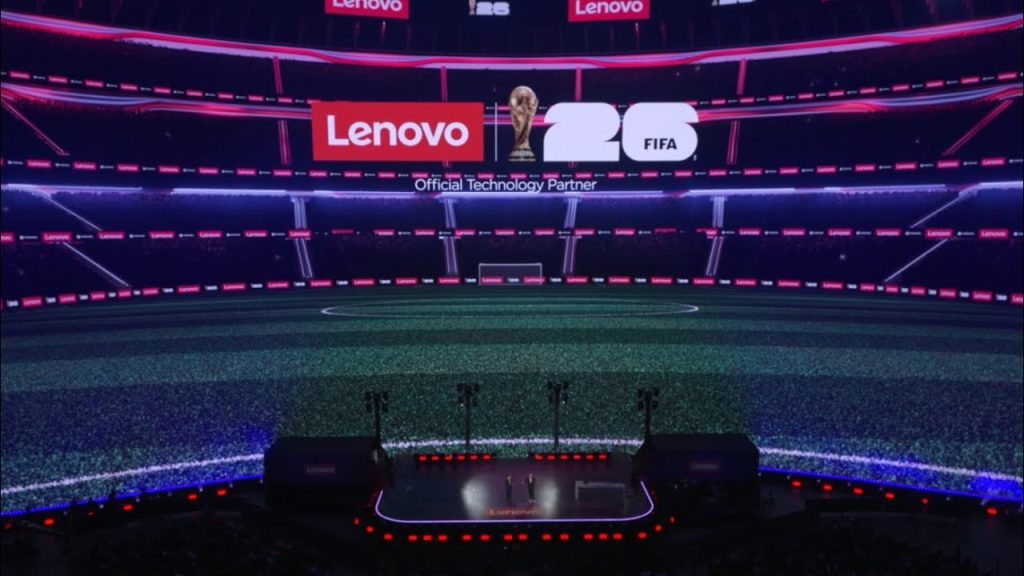
The 2026 FIFA World Cup is more than a tournament; it’s a logistical challenge on an unprecedented scale. Consider the numbers: 48 teams (up from 32), 104 matches (up from 64), spread across three countries—Canada, Mexico, and the United States. With an expected global audience of six billion people and over 180 broadcasters, the old model of relying on local organizing committees is no longer viable.
Faced with this monumental complexity, FIFA is turning to a radical new solution. AI is no longer a simple enhancement; it’s becoming the central nervous system for the entire operation. This is FIFA’s AI playbook, a blueprint for the future of global mega-events.
The On-Field Revolution: AI for Perfect Clarity
Two of FIFA’s most visible AI initiatives are designed to solve football’s most persistent controversies: officiating and offside decisions. The goal is to use technology to create undeniable transparency.
Solving the VAR Problem with AI-Powered Eyes
The updated Referee View uses AI-powered stabilization to smooth out footage from the referee’s body camera in real-time. While it will look great on screen, its true purpose is to rebuild trust. By providing clear, stable footage of what the referee sees during a critical decision, it aims to demystify the VAR process for fans and reduce controversy. It’s a governance tool disguised as a broadcast feature.
Ending Offside Debates with 3D Player Avatars
Semi-automated offside technology works, but its 2D line graphics often confuse and frustrate fans. The new system creates hyper-accurate 3D models of each player. When a close offside call happens, these avatars produce imagery that is not only more precise but also far easier for the human eye to understand, closing the gap between the correct call and audience acceptance.
The Off-Field Brain: AI for Smarter Operations
Behind the scenes, FIFA is deploying an even more powerful suite of AI tools to manage the tournament’s immense logistical and strategic demands.
Football AI Pro: Democratizing Data for All 48 Teams
Historically, only elite footballing nations could afford dedicated analytics departments. Football AI Pro levels the playing field. This generative AI assistant, trained on FIFA’s vast proprietary data, will provide every team with the same high-level pre- and post-match analysis. It can generate insights in multiple languages through text, video, and 3D visualizations, giving every coach a powerful analytical baseline.
The Intelligent Command Centre: The Digital Backbone
Perhaps the most critical piece of the puzzle is FIFA’s new “intelligent command centre.” This AI-powered hub connects real-time data from every department, venue, and broadcaster into a single operational view. In a tournament spanning three countries, this system is the only way to ensure seamless coordination. It’s the enterprise AI backbone that makes the entire, centrally-run operation possible.
The Engine Room: The FIFA Football Language Model
Powering these innovations is the FIFA Football Language Model, a domain-specific model trained exclusively on hundreds of millions of FIFA-owned data points. Why is this so important?
- A general AI like ChatGPT knows about football.
- FIFA’s model has validated, tournament-specific intelligence that no public model can replicate.
This proprietary model is FIFA’s core strategic asset. After the 2026 World Cup, it can be scaled to fans and the 211 member federations, creating a truly global, democratized football intelligence platform.
More Than a Game: A Blueprint for the Future
The 2026 World Cup is more than the ultimate test for FIFA; it’s a proof of concept for any organization facing large-scale, international operational challenges.
By taking direct control and building an AI-native infrastructure, FIFA is creating a blueprint for the future of mega-events. The World Cup is just the first test. What they build on top of it will change the game forever.