Every manufacturing leader knows the feeling: a multi-million dollar automation system, trained to perfection in a digital environment, fails the moment it hits the unpredictable reality of the factory floor. This is the “sim-to-real” gap—a costly and persistent barrier where digital models clash with real-world physics, lighting, and material variations.
For years, this problem has forced engineering teams into expensive cycles of physical prototyping, delaying launches and inflating budgets. Now, a landmark partnership between ABB Robotics and NVIDIA is designed to close that gap for good, moving physical AI from the lab to the production line with unprecedented accuracy.
The Breakthrough: RobotStudio HyperReality
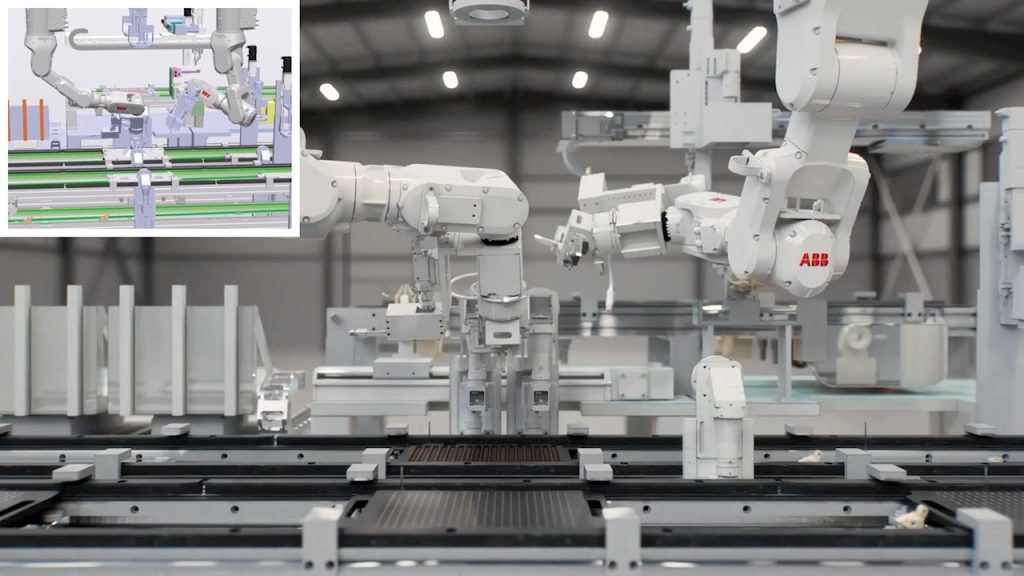
The solution is RobotStudio HyperReality, a platform that embeds NVIDIA’s powerful Omniverse simulation libraries directly into ABB’s existing RobotStudio software. This creates more than just a simulation; it creates a physically accurate digital twin of the entire automation cell.
This allows engineers to design, test, and validate a complete production line—robots, sensors, lighting, and parts—in a hyper-realistic virtual environment before a single piece of hardware is installed. The result is a 99% behavioral match between the digital twin and its physical counterpart.
From Virtual Design to Real-World ROI
By shifting to this digital-first approach, the benefits are immediate and quantifiable. The ABB and NVIDIA collaboration allows manufacturers to:
- Slash Deployment Costs by up to 40% by eliminating physical prototypes.
- Accelerate Time-to-Market by as much as 50% by validating processes virtually.
- Drastically Reduce Commissioning Time by up to 80% on the factory floor.
- Achieve Unprecedented Precision, cutting positioning errors from a typical 8-15 mm down to just 0.5 mm.
As Marc Segura, President of ABB Robotics, stated, this partnership has “closed technology’s long-standing ‘sim-to-real’ gap—a huge milestone to deploying physical AI with industrial-grade precision.”
Proof in Production: How Industry Leaders are Using It
This isn’t just a theoretical advancement. Early adopters are already proving its value on active production lines.
Foxconn, the electronics manufacturing giant, is leveraging the platform to tackle the complexities of consumer device assembly. By using synthetic data to virtually train its systems, Foxconn can achieve high accuracy from day one, dramatically cutting setup time for new product lines.
Similarly, automation provider Workr is using the technology to enable its systems to onboard new parts in minutes, a task that once required extensive, specialized programming.
The Competitive Edge: Why This Changes Everything
The collaboration between ABB and NVIDIA marks a fundamental shift in how factory automation is deployed. By integrating high-fidelity simulation directly into the robotics workflow, it de-risks investment, accelerates innovation, and delivers a powerful competitive advantage.
As AI continues to move from pure software into the physical operations of hardware, the ability to master this digital-first approach will define the next generation of manufacturing leaders. The question is no longer if companies will adopt this technology, but how quickly they can do so to stay ahead.