The assembly line is changing forever. Forget the distant promise of science fiction—in BMW’s Leipzig, Germany plant, humanoid robots are no longer a concept. They’re the new colleagues clocking in for a shift.
In a landmark move for European industry, BMW Group has deployed autonomous humanoid robots into its live manufacturing process. This isn’t just a pilot project; it’s a clear signal that the era of physical AI in the industrial heartland has arrived, moving from North American labs to the unforgiving standards of German engineering.
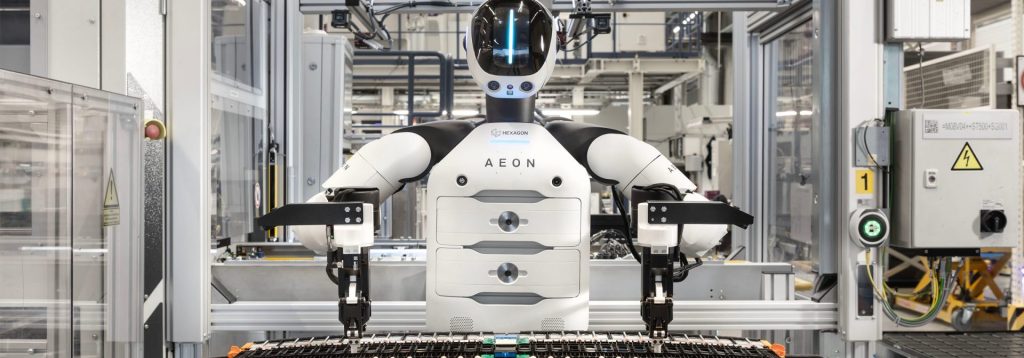
At the center of this transformation is AEON, a wheeled humanoid robot from Hexagon Robotics. This machine was designed with a singular, clear-eyed purpose, as Hexagon Robotics President Arnaud Robert stated, “We’re not in the dancing business–we’re in the working business.”
This industrial-first philosophy is evident in its design. AEON is not a flashy demo; it’s a pragmatic workhorse engineered for the realities of a factory floor.
Key Specifications:
- Mobility: Moves on wheels, not legs, for superior speed (2.5 m/s) and energy efficiency on flat factory floors.
- Endurance: Capable of 24/7 operation thanks to a 23-second autonomous battery swap.
- Awareness: A suite of 22 sensors provides full 360-degree spatial awareness for navigation, safety, and even quality inspection tasks.
- Versatility: Its human-like torso can be fitted with various grippers and tools, making it adaptable for tasks from battery assembly to component manufacturing.
BMW’s deployment in Leipzig is the culmination of a deliberate, data-backed strategy. It builds directly on the lessons from a successful 10-month trial at its Spartanburg, USA plant, where a Figure AI robot worked 10-hour shifts and handled over 90,000 components.
The choice of the Leipzig plant was equally strategic. As BMW’s most comprehensive German facility—combining everything from battery production to final assembly—it’s the perfect environment to validate physical AI across the entire manufacturing spectrum.
To spearhead this effort, BMW established a Centre of Competence for Physical AI in Production. This centralizes expertise and creates a clear pathway for integrating new robotic technologies, ensuring that knowledge is shared and scaled efficiently across the entire company.
Crucially, AEON isn’t working in isolation. It’s the physical embodiment of a massive digital nervous system that BMW has been building for years. The company systematically dismantled data silos to create a uniform data platform where information is standardized and universally accessible.
This underlying architecture is what allows an AI agent like AEON to operate, learn, and adapt autonomously. The robot is powered by high-performance NVIDIA Jetson Orin computers and was trained extensively in virtual simulations using NVIDIA’s Isaac platform, a method that slashed development time from months to weeks.
This is more than just a story about one car company. It’s a proof point for a global industrial shift.
Deloitte’s 2026 “State of AI in the Enterprise” report found that 58% of companies are already using physical AI, a figure projected to hit 80% within two years. BMW’s project demonstrates that humanoid robots have officially graduated from the lab to the factory floor, meeting the brutal efficiency and reliability demands of modern production.
As Milan Nedeljković, BMW’s Board Member for Production, summarized: “The symbiosis of engineering expertise and artificial intelligence opens up completely new possibilities in production.”
The question for industrial leaders is no longer if humanoid robots belong on the assembly line. It’s how fast they need to adapt before their competitors do.